
What a Case Study Actually Shows You
A before and after photo shows you a result. A case study shows you the reasoning.
On this page we publish complete cases: what the patient came in with, what we found, what we recommended and why, and what the measurements looked like afterward. Including the numbers that did not move as much as we hoped.
Patient names are withheld. Everything else is exactly what happened.
We will add cases here as they complete. If you want to see cosmetic results instead, our before and after smile gallery has those.
Case 001, Gum Disease and Decay in a Patient Who Wanted to Keep Every Tooth
Treated by Stacey Espe, RDH, with restorative care by the dental team at our practice in Carlsbad. Seven months from first visit to final measurement.
What she came in with
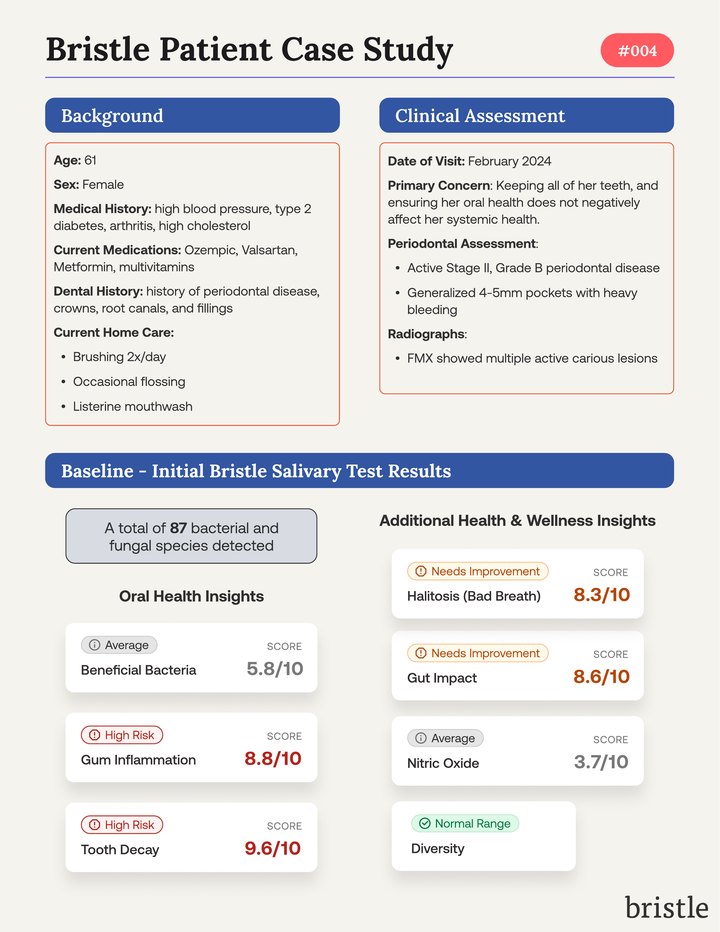
A woman in her early sixties. She was managing type 2 diabetes, high blood pressure, high cholesterol, and arthritis, and had a history of gum disease, crowns, root canals, and fillings behind her.
She brushed twice a day. She flossed sometimes. She used an antiseptic mouth rinse daily and believed, reasonably, that she was doing enough.
She told us her goal in one sentence: keep all of her teeth, and make sure her mouth was not making the rest of her health worse. She also had a family history of Alzheimer’s disease and had read about the research linking oral bacteria to cognitive decline. She wanted that addressed.
What we found
Active periodontal disease, Stage II, Grade B. Gum pockets of four to five millimeters throughout, with heavy bleeding whenever we probed them. A full set of x-rays showed several active cavities.
None of this had hurt yet. That is the part patients find hardest to believe.
What the saliva test added
We ran a Bristle salivary test, which identifies the specific bacteria living in a patient’s mouth rather than only what is visible on examination. Eighty-seven bacterial and fungal species came back.
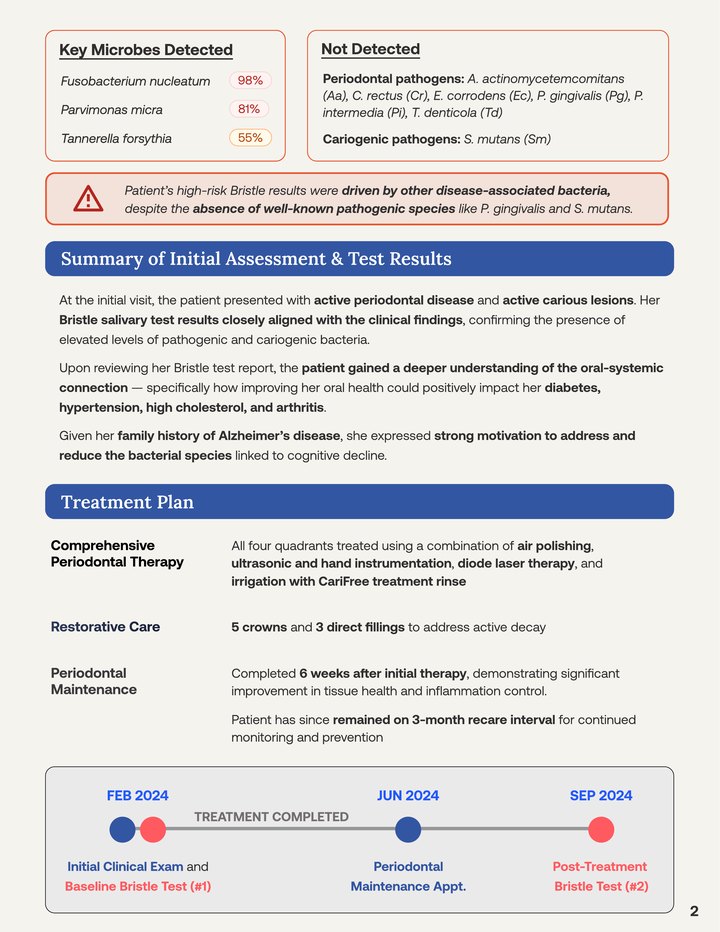
What made this case unusual is what was absent. The two most notorious culprits, P. gingivalis for gum disease and S. mutans for decay, were not detected at all. Her risk was being driven by a different group: Fusobacterium nucleatum at 98 percent, Parvimonas micra at 81 percent, and Tannerella forsythia at 55 percent.
A test looking only for the famous pathogens would have told her she was fine.
What we did
All four quadrants of periodontal therapy, combining air polishing, ultrasonic and hand instrumentation, diode laser therapy, and an antimicrobial rinse. Then five dental crowns and three fillings to address the active decay. She returned six weeks later for periodontal maintenance and has stayed on a three-month recall since.
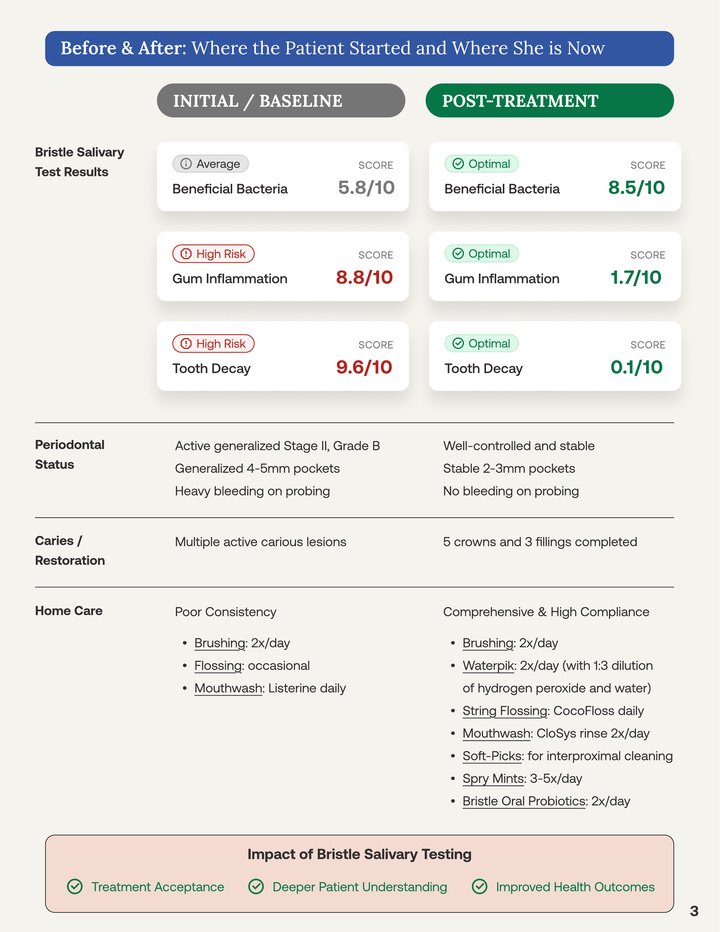
The other half of the plan was hers. She replaced her routine with a water flosser twice daily, daily string flossing, a different rinse, interproximal picks, xylitol mints through the day, and oral probiotics. Reviewing her own test results is what convinced her to do it. We had recommended most of it before. Seeing the number attached to her own mouth is what made it stick.
Seven months later
Periodontal status
- Active generalized Stage II, Grade B
- Generalized 4 to 5 mm pockets
- Heavy bleeding on probing
- Well controlled and stable
- Stable 2 to 3 mm pockets
- No bleeding on probing
Decay and restoration
- Multiple active carious lesions
- 5 crowns and 3 fillings completed
Home care
- Brushing twice daily
- Occasional flossing
- Antiseptic rinse daily
- Brushing twice daily
- Water flosser twice daily
- Daily string flossing
- Antimicrobial rinse twice daily
- Interproximal picks, xylitol mints, oral probiotics
Salivary test scores from the patient’s Bristle reports, taken at first visit and seven months later. Clinical findings from her periodontal charting at the same two appointments.
Clinically, her pockets came down to a stable two to three millimeters with no bleeding on probing. She kept every tooth.
What she reported about her general health
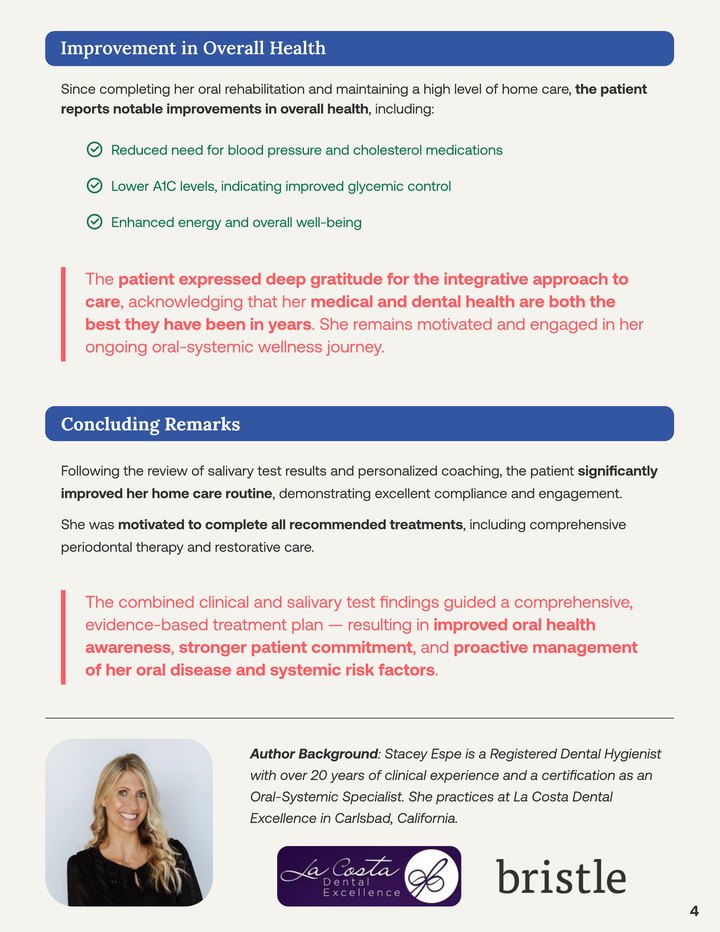
At follow-up she told us she needed less blood pressure and cholesterol medication, that her A1C had come down, and that her energy was better than it had been in years.
We want to be precise about what that does and does not mean. Those are her reports, and any change to her medication was her physician’s decision, not ours. Treating gum disease does not treat diabetes. What the research supports is narrower and still important: periodontal inflammation and blood sugar control influence each other, and reducing inflammation in the mouth removes one burden the rest of the body was carrying. This is one patient’s documented result. Yours would be your own.
Why we publish this one
Because almost nothing about it was visible. She had no pain. Her home care sounded fine when she described it. Her most dangerous bacteria were not the ones a standard risk assessment looks for.
The test did not treat anything. It changed what she was willing to do, and that is what produced the result. Consistent preventive dental care is what holds the result in place.
The Source Document
Everything above is drawn from the clinical write-up below. We are publishing it in full rather than asking you to take our summary on trust. Click any page to open it.
Because Your Health Matters
If you have been told you have gum disease, or you have been managing a condition like diabetes and wondering whether your mouth is part of the picture, that is worth an hour of conversation.
Call our office today at (760) 633-3033, or request a time that suits you.
Written by Stacey Espe, RDH, an Oral-Systemic Specialist with more than twenty years of clinical experience at La Costa Dental Excellence.
Medically reviewed by Dr. Piper Dankworth, DDS, a Kois-trained dentist whose practice emphasizes the connection between oral and whole-body health.
Reviewed August 2026